

The 5 Trends That Will Determine The Winners
Markets Are Noisier & Buyers Are More Confused Than Ever
Consider the following findings from Gartner’s research on today’s environment for buyer’s:
- 55% of customers say they encounter an overwhelming amount of trustworthy information during the buying process (emphasis mine)
- 44% struggle with the fact that information from various suppliers, while all seemingly trustworthy, was contradictory
- 89% of buyers feel that the information they encounter as part of making a purchase decision is of high quality
- Today’s customers spend 15% of their buying time reconciling or deconflicting information related to the purchase decision (emphasis mine)
All of this has a direct impact on the likelihood, quality, and satisfaction of the decisions sellers are asking buyers to make:
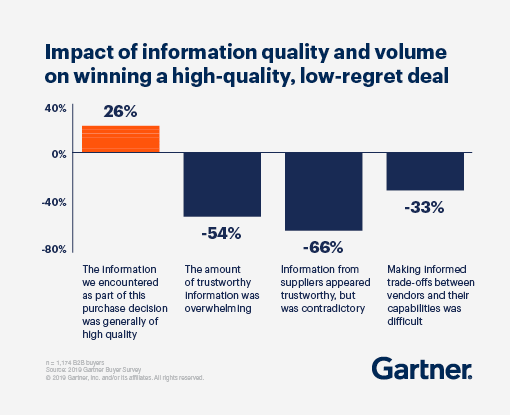
It’s no longer enough to have a strong sales process, a powerful message, and smart salespeople. Today’s top job for marketers & sellers is to enable the organizations and people in their targeted markets to make sense of their world and options (this is why Gartner refers to today’s best sales professionals as Sense Makers). Delivering on this requires new skills and mindsets and to manage more complexity through the buying journey. As Gartner Distinguished VP and coauthor of The Challenger Sale and The Challenger Customer said, “We now live in a world where insight is likely more table stakes than a differentiator.”
Good Enough Isn’t Enough Anymore
It’s no wonder that people are exhausted. Every day they’re being asked to do more with less and to do it faster at the same time. The world has been obsessed with speed, even when it comes at the expense of velocity. Customer acquisition costs are rising, margins are continually under pressure, and as the last year has illustrated, predictability appears to have been a myth.
Twenty years ago, the go-to strategy was to be disruptive. Today the biggest challenge facing every person and business is to find a path that enables you to excel in an environment that is continually disruptive or destructive.
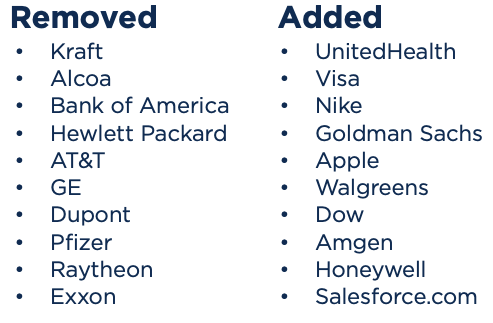
Consider the companies that make up the Dow Jones Industrial Average (DJIA), the oldest index used to assess the stock market. The 30 companies that comprise the DJIA are among the most successful in the world. You don’t become a part of the DJIA by accident.
Despite their success and deep resources (or maybe it’s because of their past success), 1/3rd of the Dow is out. When you look at the differences between the companies, meaningful insights present themselves.
There’s A New Game, And Winning It Requires A New Mindset & Approach
”In business, the new game begins before the old one ends” - Clayton Christensen, author & Harvard Business School professor
The game businesses are playing has changed. There are new rules, new risks, and new stakes. For decades businesses have paid lip service to the idea that the customer is everyone’s boss. Today your business better be taking that adage seriously. And I’ve got some news, our boss - the customer - is fickle, demanding, and often has unreasonable expectations.
Winning this new game requires a transformation in mindset and approach.
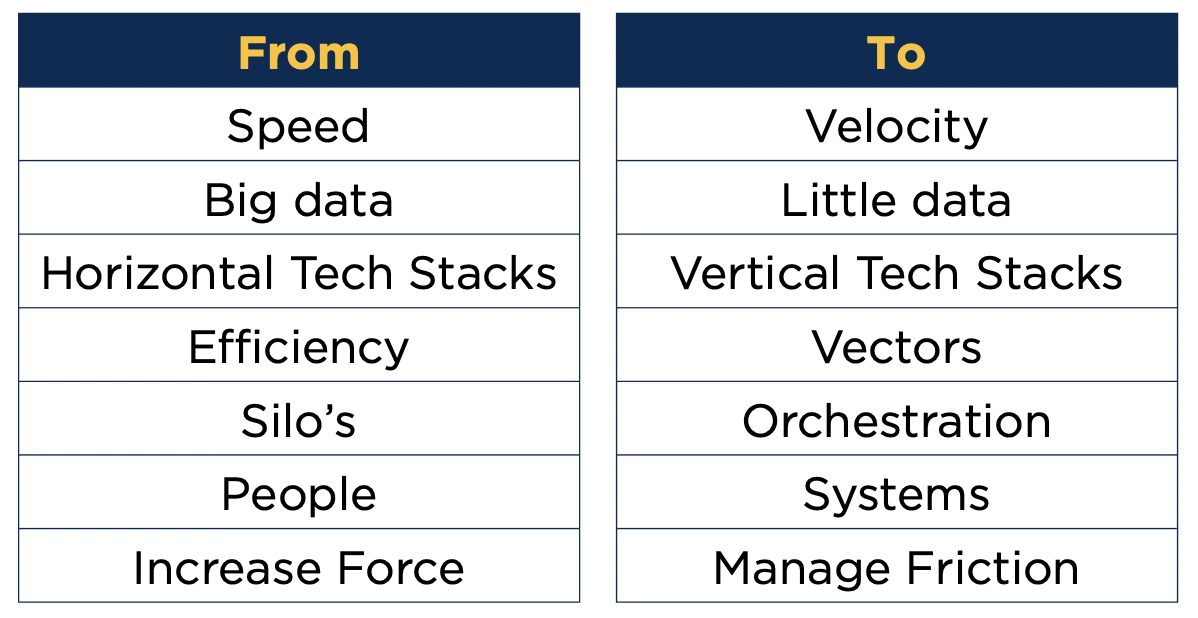
- From a focus on speed to a focus on velocity: speed is a measurement of how fast you’re moving, velocity measures how quickly you’re progressing towards a specific point. In the old game, it was good enough to be overly focused on speed. Today’s game is too complicated, dynamic, and nuanced for speed alone to get the job done.
- Shifting from levering Big Data and utilizing Little Data: In her book Thinking in Bets, author and former World Series of Poker Tournament of Champions winner Annie Duke shared that outcomes are determined by two variables: decision quality and luck. The only variable businesses can directly impact is decision quality. In the December 2013 Harvard Business Review article You May Not Need Big Data After All, the authors shared that data’s primary value is improving decision quality. While that statement may seem obvious, few companies are using it effectively. The authors called for an approach they call “evidence-based decision making.” We call it Hypothesis Driven Growth. Companies and individuals that embrace hypotheses driven decision making will accelerate velocity with less effort. Those that don’t will continually be forced to work harder for diminishing returns.
- Away from bloated, redundant Horizontal Tech Stacks to tight, purposeful Vertical Tech Stacks: Here’s a Twitter post that, without meaning to, is the most accurate statement of the technology trend in sales and marketing over the last decade. This tweet aims to define the sales essentials, listing 12 applications - TWELVE!! I don’t know what’s worse, the fact that this only represents one segment of the sales, marketing, and success processes, or that I can quickly identify five applications that are missing.
Here’s the reality, 99.8% of sales organizations don’t need 12 applications to accelerate their sales efforts. As technology budgets have exploded, company leaders realize that the only measurable impact these “investments” have generated is greater SaaS subscription costs. A few years ago, a study showed that their conversion rates went down as companies spent more on sales and marketing tech. In the new game, it’s not a question of how much technology you have; it’s a question of how are you utilizing the technology you do have?

- From an obsession with efficiency to a focus on aligning vectors: Sales and marketing in the 21st century can be described as an obsessive pursuit of efficiency. It is undoubtedly true that many aspects of the customer and revenue acquisition and expansion areas are far less efficient than they should be. The problem is that organizations are pursuing efficiency as though the desired outcome/objective is greater efficiency. You can see it in the key metrics that increasingly dominate dashboards, reporting, comp plans, the implemented structures, and the tactics that permeate the entire process.
The current state today reminds me of the problems the manufacturing industry had to confront in the 1980s. Manufacturers used to obsess about efficiency too. As a result, they got good at being efficient. The problem they encountered was the more efficient they got, the more money they lost, and they became less responsive to changing circumstances, which multiplied the impact of those losses.
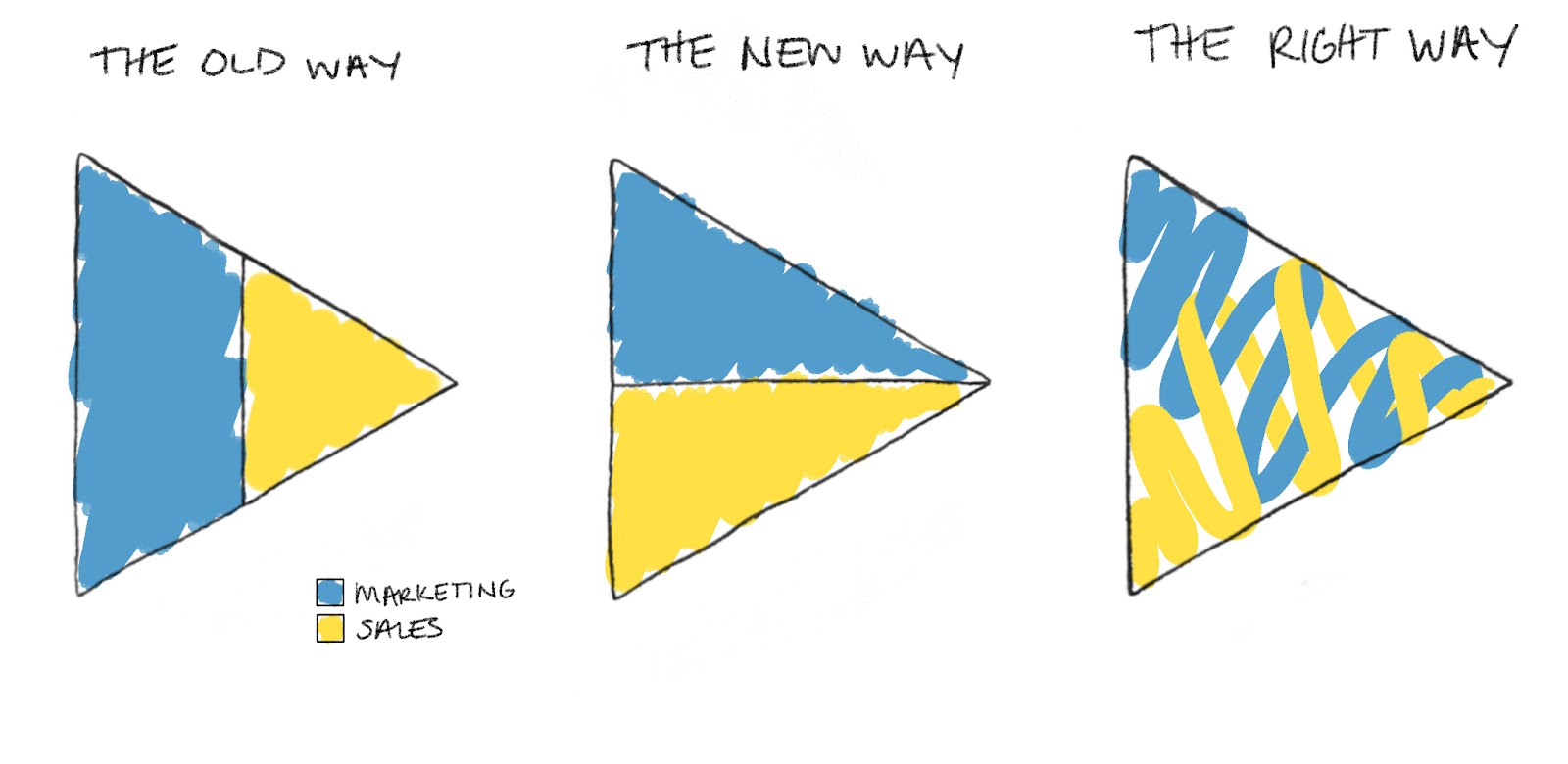
What the manufacturing industry learned is what sales organizations need to know to win in this new game. Efficiency is only a means; throughput should be the outcome/objective. Businesses must focus on aligning their vectors to account for and mitigate the various bottlenecks and constraints inherent in rich, complex, adaptive systems like the market. - Away from silos to orchestrated action: For most of the 20th-century, sales and marketing teams worked in clearly defined roles that, while complementary, were easily separated. Marketing was responsible for the early part of the customer acquisition process, and sales own the later part. The Internet and greater competition disrupted all of that, leading to a shift in how these groups worked. Rather than the linear path of old, they had to work more in a parallel manner. Despite all the rhetoric and content about sales and marketing alignment, these teams still operate, primarily as separate silos.
Winning the new game will require companies to position, market, and sell themselves in new, complex ways. The demands of the new game are far too much for mere alignment to be enough. The companies that win the game will see marketing and sales working in highly orchestrated ways. Managing such orchestration without it devolving into chaos or confusion will become one of the primary leadership demands.
- Away from managing behavior to systems & design thinking: In their peak years, IBM built the greatest sales organization in the world’s history. They did it by creating a superior system, not by hiring superior salespeople. They followed the path recommended by Peter Drucker and built the genius into the system.
I’ve spent more than 30 years in the sales industry, working in just about every facet of the sales echelon. One of my most significant observations is that salespeople get far more credit than they deserve when sales are good and far too much blame when they’re not. I’ve learned that it’s far better to be an average salesperson in a superior system than a great salesperson in an average one.
The challenge presented by the new game is that the customer/revenue acquisition and expansion systems have become far more complex, dynamic, and adaptive. This makes building a sustainable system harder than ever. The winners of the new game will embrace systems and design thinking. In much the same way that business model innovation has been the primary competitive advantage for companies in the past decade, a complex systems approach will become a critical competitive advantage in the next. - Less of “doing more” and More about managing friction: At Lift, we like to talk about a companies growth efforts using the metaphor of a flywheel. Historically the go-to play of successful organizations was to increase the force used to move the flywheel. By and large, this has worked for the organizations that have done it well. The problem is that after some progress, increasing force reaches a diminishing point of returns. As you apply more and more force, gains diminish.
The new game will see a second play dominate. The winners of the new game will manage friction to achieve their desired outcomes with less effort.
The Revenue Acceleration Framework™ - The Structure For Smart Growth
Consistently winning quality business today requires a complex and coordinated approach. We’ve studied thousands of small and mid-market companies that have successfully navigated the complicated growth journey. While each company has its distinct approach, they all follow a similar framework, what we call The Revenue Acceleration Framework:

Execution
“Everyone has a plan until they get punched in the mouth.” - Mike Tyson

In the end, it’s what you do, not what you plan to do, that determines your outcomes. Winning with today’s customers requires extensive orchestration between sales, marketing, operations, technology, and more.
The markets we compete in today are complex, dynamic, and adaptive. This means there is no one strategy or path to success. The rate of change today is extraordinary, and it’s only increasing.
The battle cry of today’s buyers and sellers is simple - Don’t Make Me Think. Yet far too often, that’s precisely what companies’ approaches to execution do. Rather than designing and structuring up-front, we allow conflicts to appear and be resolved at the performance point. This type of friction extracts value, slows things down, and drains the resources businesses need to thrive.
On the other hand, a well structured and designed framework ensures that vectors are aligned, activities are orchestrated, freeing up the space needed to execute effortlessly. Adjustments are continuously made, and trade-offs are managed proactively to enable people to build momentum.
The Crucial Role of Strategic Revenue Operations
Revenue Operations: The strategic coordination of all market-facing, revenue-oriented systems, processes, and activities designed to increase velocity, optimize throughput, and reduce the friction (effort) required to solve for the customer & achieve revenue objectives.

Strategic Revenue Operations manages the invisible and ensures that the customer & revenue acquisition & expansion efforts work holistically in complex, competitive, and adaptive conditions. RevOps is (or at least should be) charged with orchestrating the assets available to sales, marketing, and success teams to accelerate and optimize outcomes.
RevOps is responsible for eliminating negative friction before the point of execution.
Tactical vs. Strategic Revenue Operations

Today revenue operations is among the fastest-growing disciplines in sales and marketing. It’s important to note that not all revenue operations mindsets are the same. We recently shared a post highlighting The Five Levels of Revenue Operations. The key takeaway from our research is the difference between a tactical and strategic revenue operations focus:
- Tactical RevOps: focus on efficiency
- Strategic RevOps: focus on vector alignment and outcomes
There are only two activities that can increase your momentum. They are to increase force or reduce friction. Increasing force (doing more) quickly hits the points of diminishing returns. When the focus is on “more,” costs go up, as does the complexity. When you’re focused on force, the increased friction eliminates much of the value you seek to create.
Reducing friction enables the entire organization. It makes everything you do more efficient and usually more effective. It allows people to get more from the time and effort they put forth, and it gives the organization more stability.
The 7 Disciplines of Strategic RevOps
The Strategic RevOps mindset is on managing friction to optimize results. Making the trade-offs required to accelerate outcomes requires companies to master seven operational disciplines.
1. Database Management & Optimization: data is a crucial component of revenue operations. Revenue operations “owns” the database, ensuring data integrity optimizing its use.
2. Process Compliance & Optimization: a core thesis of this article is that you must execute with purpose and intent to win in the new game. This means you must have robust systems and processes in place. Operations teams often get themselves into trouble here because they focus on only one part of compliance. One of my favorite images highlights the difference between how people think things should work vs. how they do. A healthy revenue operations team views compliance as a two-way feedback system. When processes aren’t followed, they determine if it’s the process or the user behavior that needs adjustment (usually both).
3. Manage & Optimize The Tech Stack: companies are spending more money than ever on technology for marketing and sales, yet more often than not, they end up with bloated, horizontal tech stacks that add as much friction as they eliminate and drive up costs. Effective RevOps teams follow The 5 Principles For Building An Effective Growth Tech Stack, ensuring it’s implemented as a tight, vertical stack to enable and accelerate performance.

4. Data Science: it’s a term that gets thrown around a lot but often doesn’t get the attention and follow-through that’s required. RevOps is crucial to execute what we like to call Hypothesis-Driven-Growth by appropriately utilizing data science. What is data science? It’s a hypothesis-driven method of getting answers and learning things. Data science is taking that method and applying it to your data to answer questions, understand something, and guide future actions.
5. Territory & Compensation Management: the way sales teams are structured and organized ultimately has as much impact on a company’s ability to sustain growth as how it recruits, selects, and hires salespeople, yet it gets far less attention and consideration. In our work analyzing sales teams, we regularly see underutilized resources, forcing companies to hire more salespeople than necessary or sacrifice growth opportunities. One of the top three reasons for this is poorly structured teams.
There are few things more misunderstood and misapplied than sales compensation. The first failure is based on the belief that compensation schemas serve as motivate behaviors. Comp systems are used when better processes or better management are needed, leading to negative consequences.
Strategic RevOps utilizes the strategies surrounding sales team structure (territory management) and compensation to reinforce the overall system design and drive better predictable outcomes.
6. System Design Optimization: as a business grows, it takes on more complexity and friction. The structure and underlying design of the system is the prime determinant of outcomes. People can overcome poorly designed systems in bursts, but ultimately the system prevails. Strategic revenue operations bring design and systems thinking to create the structure that reduces the effort required to execute to sustain its momentum.
7. Behavioral Science & User Experience: ultimately, it’s what people do to determine whether you meet your objectives. Strategy, tactics, messages, etc., are all wonderful, but in the end, it’s the behavior of the people involved that matters. Strategic RevOps is maniacally focused on ethically influencing the behaviors and experience of all stakeholders. They work to make it easier for people to take desired actions and more challenging to take steps that aren’t wanted. Deeper understanding and applying behavioral science are likely to become a vital component to create and exploit a competitive advantage.
Introducing The Revenue Acceleration Program™
Imagine, problems solved, and barriers overcome before you encounter them.

When we began our journey investigating revenue operations’ role, one word dominated our inquiry - why. Why revenue operations? The answer came quickly. The reason for revenue operations is to accelerate revenue gains.
Revenue Acceleration requires a different mindset. It requires that you view aspects of revenue capture holistically and integrate disciplines from outside of the traditional sales and marketing into the mix, specifically design & systems thinking and behavioral & data science.
We’ve synthesized the Revenue Acceleration Methodology into three stages:
1. Perform: the performance zone is the next 90 days. The focus is on execution to meet your objectives and “hit the number.”
2. Enable: the enablement zone is the next 12 months. This is the timeframe where improvements are staged, operationalized, systematized, and optimized. The enablement zone’s job is to synthesize the strategy and change initiatives that enable and accelerate the performance of those responsible for the day-to-day execution.
3. Transform: the transformation zone is the mid-term (1-3 years). The focus is on translating the business’ vision, building capabilities, and activating change initiatives.
The Revenue Acceleration Program orchestrates the revenue acceleration process elements, enabling you to generate a 15% to 37% greater impact from your existing efforts and investments.